I still get asked this in almost every first call: so is technical SEO the same as on-page SEO, or different things? It’s a fair question. The two terms get thrown around together so often that most people assume they’re basically synonyms, or close enough that the distinction doesn’t matter.
It matters. I’ve seen a site with genuinely excellent content sit invisible in search for months, because nobody caught a stray noindex tag. I’ve also seen technically flawless sites rank nowhere, because the content never answered what anyone was actually searching for. Different problems need different fixes, and knowing which one you’re looking at saves a lot of wasted effort.
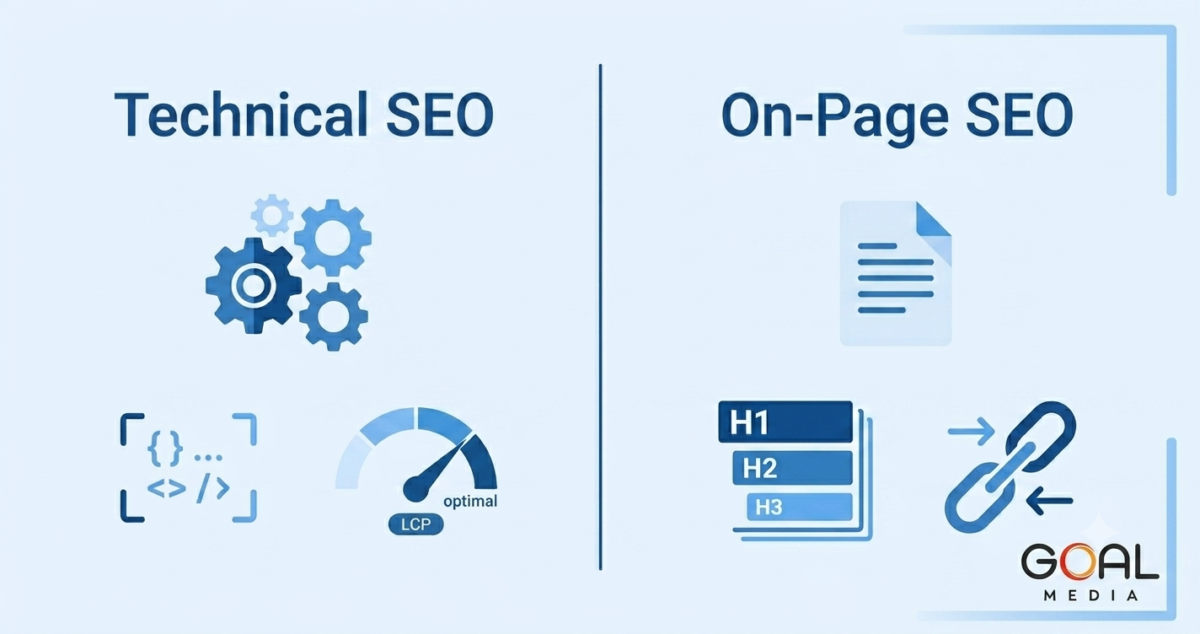
Short version: technical SEO makes sure search engines can find and understand your site. On-page SEO makes sure that once they can, your pages are actually worth ranking. One’s about access. The other’s about relevance. You need both, and they’re not interchangeable.
What Technical SEO Actually Covers
Technical SEO happens mostly under the hood, in your site’s infrastructure rather than its visible content. It’s the work that lets Googlebot reach your pages, render them properly, understand their structure, and add them to the index without wasting effort along the way.
When it’s working, nobody notices. When it’s broken, pages go missing from search results no matter how good the writing is.
What falls under this:
- Crawlability. Can search engines actually reach your pages: robots.txt, internal links, crawl budget.
- Indexing. Do reachable pages actually make it into the index.
- Site speed and Core Web Vitals. LCP, INP, CLS.
- Site architecture. How pages are organised and linked into a structure.
- Structured data. Schema markup that helps engines understand content.
- Canonicals and redirects. Preventing duplicate-content confusion.
- Mobile and rendering. Making sure JavaScript content actually reaches Google.
Think of it as the plumbing. You don’t see it working. You definitely notice when it breaks.
What On-Page SEO Actually Covers
On-page SEO is the work you do directly on a page to make it relevant and competitive for the terms you want it to rank for. If technical SEO gets you access, on-page SEO earns the ranking once you’re in.
It’s the part most people picture when they think “SEO,” because it’s visible: the content itself, how it’s written, how it’s organised around a topic.
What falls under this:
- Title tags and meta descriptions. What shows up in search results.
- Headings. The structure that signals what a page is about.
- Content quality and relevance. Does the page actually answer what someone’s searching for.
- Keyword usage. Used naturally, not stuffed.
- Internal linking. Connecting related pages so relevance flows between them.
- Image optimisation. Alt text, sensible file sizes.
- Content structure. Easy to scan, easy to parse.
Technical SEO gets a page in front of Google. On-page SEO gives Google a reason to rank it.
Where People Get Confused
The overlap that trips people up is content structure and internal linking. Both disciplines touch them. Technical SEO cares whether your internal links create an efficient crawl path. On-page SEO cares whether those same links pass topical relevance to the right pages.
That’s not a contradiction. It’s actually the reason these two work best handled together rather than as separate projects run by separate people who never talk to each other. I’ve seen that happen more than once, and it never ends well.
Which One Should You Fix First
Almost always, technical first.
The logic is simple enough. On-page improvements only pay off on pages that search engines can crawl, render, and index in the first place. Rewrite the perfect title tag on a page that’s blocked by a stray noindex, or so slow it fails Core Web Vitals, and you’ve just polished something Google can’t properly see yet.
So the order that actually works:
- Fix the technical foundation. Make sure important pages are crawlable, indexable, fast, and free of structural blockers.
- Then optimise on-page. Once pages render correctly, sharpen the content, titles, and internal linking to compete for the right terms.
- Keep doing both. New content needs on-page attention. Site changes introduce new technical issues. Neither is a one-time task.
One exception worth naming. If your site’s already technically solid, clean crawling, fast, fully indexed, on-page work becomes the higher-leverage move. The “technical first” rule matters most when something is actually broken underneath. An audit is the only real way to know which situation you’re in, rather than guessing.
Do You Need Both?
Yes. Neither compensates for the other.
A technically flawless site with thin content gets crawled and indexed beautifully, and still won’t rank, because there’s nothing worth ranking. Brilliant content sitting on a broken technical foundation never gets indexed properly, or loads so slowly people leave before reading a word.
The sites that actually perform treat these as one connected system rather than two separate checklists. A clean technical foundation lets engines reach and understand pages. On-page work makes those pages deserve to rank once they’re found.
A Quick Way To Tell Which One You’re Dealing With
Signs point to technical:
- Pages missing from Google entirely (check
site:yourdomain.com) - Traffic dropping with no obvious content cause
- Search Console showing crawl errors or “discovered, not indexed”
- Site’s slow or failing Core Web Vitals
- Rankings dropped right after a migration or redesign
Signs point to on-page:
- Pages are indexed but stuck on page two or three
- You’re ranking, just for the wrong keywords
- Titles and headings don’t clearly target a topic
- Competitors with similar authority consistently outrank you
- Content exists but doesn’t fully answer the search
Seeing the first list, start technical. Seeing the second, your foundation’s probably fine and on-page is where the gains are. Seeing both, which happens more often than either alone, a proper audit tells you what to fix and in what order instead of guessing.
Where This Leaves You
Technical SEO earns your pages access to the index. On-page SEO earns them the ranking once they’re there. Fix the foundation first, then make every page that’s actually reachable as relevant and competitive as it can be.
If you’re not sure which side is holding your site back, that’s exactly what a technical SEO audit is for. It diagnoses the crawl, indexing, speed, and structure issues you can’t see from the outside, and tells you what to fix first.
Frequently Asked Questions
Is technical SEO the same as on-page SEO?
No. Technical SEO handles your site’s infrastructure: crawling, indexing, speed, architecture, so search engines can access and understand your pages. On-page SEO handles individual pages: titles, headings, content, internal links, so they’re relevant and competitive for target keywords. They overlap on content structure and internal linking, but they’re solving different problems.
Should I do technical SEO or on-page SEO first?
Technical usually comes first, because on-page improvements only help on pages search engines can actually crawl and index. The exception is a site that’s already technically healthy, where on-page becomes the higher-leverage work. An audit is the reliable way to know which situation applies, rather than guessing based on symptoms alone.
Can good content make up for poor technical SEO?
Not reliably. A page blocked from indexing, buried where Googlebot rarely reaches it, or failing Core Web Vitals may never rank no matter how good the writing is. Technical issues act as resistance against everything else you do. Strong content and a clean technical foundation work together. Neither one covers for the absence of the other.