Every business expanding into new countries hits this decision, usually later than they should. Do you run germany.yoursite.com, yoursite.com/de/, or yoursite.de as its own domain? The answer gets debated in agency pitches more than it probably deserves, because the honest truth is: the structure matters less than what most people assume, and the thing that actually decides it is rarely SEO at all.
I’ve seen businesses agonise over this choice for weeks, then launch with whichever structure their developer found easiest to build — and it worked fine. I’ve also seen businesses pick the “SEO-optimal” structure on paper and get a messier result than if they’d just gone with what their team could actually maintain. So before comparing the mechanics, it’s worth saying plainly: this decision should follow your resources and infrastructure, not the other way around.
The Three Options, Briefly
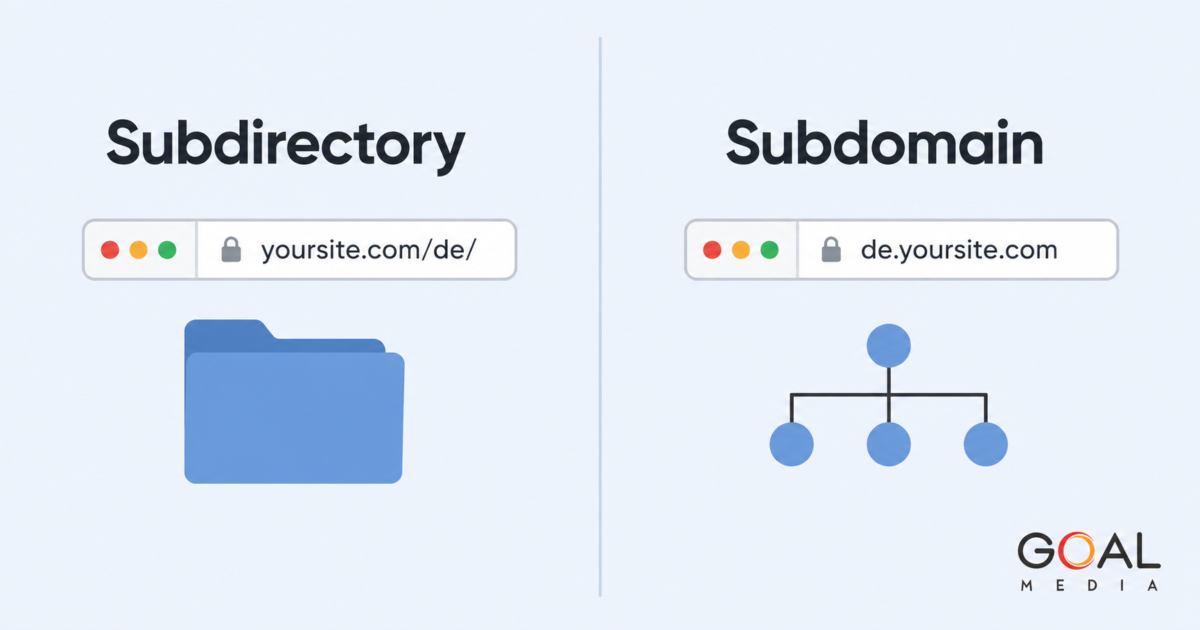
Subdirectories (yoursite.com/de/) keep everything under one domain, with country or language folders underneath. All the authority your main domain has built lives in one place and extends to every subfolder automatically.
Subdomains (de.yoursite.com) sit technically apart from the main site — same domain family, but Google has historically treated them as somewhat separate entities, closer to their own site than a folder would be.
Country-code top-level domains, or ccTLDs (yoursite.de) are fully separate domains. Maximum signal to both users and search engines that this is a dedicated presence for that market, and maximum operational overhead to match.
Where Google Actually Stands On This
Google has said for years that subdirectories, subdomains, and ccTLDs can all rank well, and there’s truth to that — plenty of sites succeed with each. But “can all work” isn’t the same as “all equally easy,” and the practical differences matter more in day-to-day execution than in theory.
Subdirectories inherit your main domain’s authority immediately. A brand-new /de/ folder benefits from every backlink, every bit of trust your .com has already earned. That’s the single biggest practical advantage, and it’s why subdirectories are usually the fastest path to visibility in a new market.
Subdomains, by contrast, often need to build some authority of their own before they perform well — not always, but often enough that it’s worth planning for. Google’s crawlers can treat a subdomain as sufficiently distinct that it doesn’t fully inherit the parent domain’s trust the way a subfolder does.
ccTLDs sit furthest from the parent site’s authority. A yoursite.de effectively starts from close to zero in Google’s eyes, gaining strong local-relevance signals (which genuinely help) but losing the head start your existing domain would have given it.
The Question Nobody Asks Early Enough: Who’s Maintaining This?
Here’s where businesses usually miscalculate. The technical SEO difference between these three options is real but modest. The operational difference is not.
A subdirectory structure means one codebase, one hosting setup, one team managing everything. A new market is a folder, not a project. Subdomains often mean a semi-separate setup — sometimes shared infrastructure, sometimes not, depending on how it’s built. ccTLDs frequently mean fully separate hosting, separate DNS, sometimes separate content management entirely — and if that’s not planned for, they become the thing that quietly stops getting updated eighteen months in.
I’ve watched a ccTLD sit untouched for over a year because nobody remembered it needed separate maintenance from the main site. That’s not a hypothetical risk — it’s the most common real failure mode with this structure, and it costs far more than any SEO difference between the three options.
When Each Option Actually Makes Sense
Subdirectories work best for most businesses expanding into a handful of new markets, especially early on. If you’re targeting three to eight countries and don’t have a dedicated team per market, this is almost always the sensible default. It’s also the right call if your content strategy is largely shared across markets with local adaptation, rather than fully distinct per country.
Subdomains make sense when a market genuinely needs separate infrastructure — different tech stack, different team, different release cycle — but you still want it under the same brand domain rather than launching an entirely new one. This is less common than people assume; most businesses that reach for subdomains could run a subdirectory just as well.
ccTLDs earn their overhead when a market is large enough and permanent enough to justify a dedicated presence — often after a subdirectory has already proven the market works. Some regulated or highly localised markets also expect a local domain as a trust signal; certain government or financial services searches genuinely perform better with a local ccTLD, independent of the SEO argument. If you’re not sure whether your market falls into that category, it probably doesn’t yet.
What Matters More Than The Structure You Pick
Whichever structure you choose, the same underlying signals decide whether it actually works:
Correct hreflang implementation, so search engines understand which page serves which language and region — get this wrong and you risk showing German users your English homepage, structure notwithstanding. Genuinely localised content, not machine-translated pages with the same generic phrasing across ten markets. Consistent internal linking between markets, so authority and relevance flow properly rather than isolating each region. And a realistic maintenance plan — because an under-resourced ccTLD underperforms a well-maintained subdirectory every time, regardless of what the theory says about domain authority.
This is the part that gets skipped in most “subfolder vs subdomain” comparisons, and it’s the part that actually determines the outcome. The structure sets the stage; execution decides the result.
A Practical Way To Decide
If you’re weighing this now, a few honest questions settle it faster than reading another comparison chart: How many markets are you targeting in the next two years — a handful, or a genuinely large number? Do you have (or can you realistically build) a team to maintain separate infrastructure if you go the subdomain or ccTLD route? Is your content strategy shared across markets with local adaptation, or does each market need something structurally different? And is there a specific market where local trust signals matter enough — regulated industries, certain government-adjacent sectors — to justify a dedicated domain regardless of the SEO trade-off?
For most growing businesses expanding into international search, the honest answer is a subdirectory structure, properly localised, with hreflang implemented correctly from day one. It’s not the most impressive-sounding choice, but it’s the one that’s actually maintainable — and a structure nobody maintains loses to a simpler one that gets proper attention every time.
If you’re planning an international expansion and want a second opinion on structure before you build anything, our international SEO services page covers how we approach market targeting, hreflang, and multilingual content — useful groundwork whether you bring us in or handle it yourselves.
Frequently Asked Questions
Is a subdirectory or subdomain better for international SEO?
Subdirectories are generally the more practical choice for most businesses, mainly because they inherit your main domain’s existing authority immediately, while subdomains often need to build some trust of their own. The gap has narrowed over the years, but the operational simplicity of a subdirectory — one site, one team, one set of infrastructure — usually outweighs the marginal SEO differences.
Do I need a ccTLD to rank well in a specific country?
No, not for most markets. Google has confirmed subdirectories and subdomains can rank well locally when paired with correct hreflang and genuinely localised content. ccTLDs help in specific cases — some regulated industries or markets where local domain ownership signals trust — but for most businesses, a well-executed subdirectory performs just as well without the added infrastructure burden.
What’s the biggest mistake businesses make with international site structure?
Choosing a more complex structure than they can actually maintain. A ccTLD or subdomain that gets updated once and then neglected performs worse than a simple, well-maintained subdirectory. The structure matters less than whether someone is actually keeping the content, hreflang tags, and local relevance current over time.