Every growing business runs into this decision eventually. You know you need content — for search visibility, for credibility, and for the leads that come from both — and now someone has to produce it.
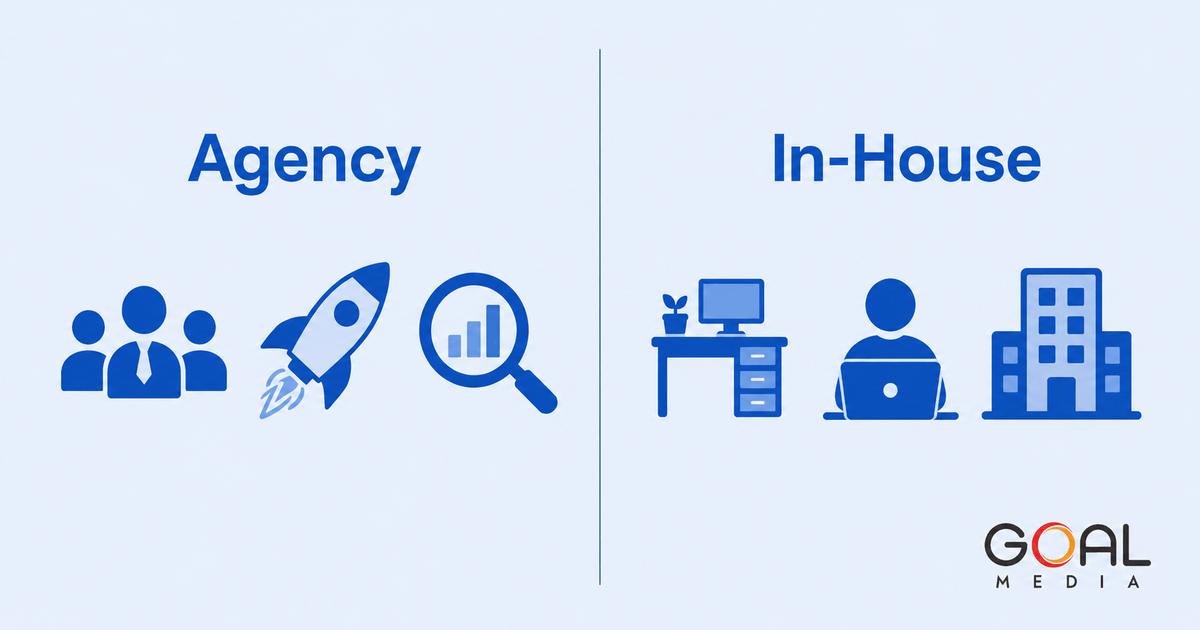
Should you hire a content marketing agency, or build an in-house content team?
That’s the qualitative side of the decision. If you want the actual cost and breakeven math instead, specifically for B2B and SaaS budgets, I’ve broken that down separately in Content Marketing Agency vs In-House Team: Real ROI.
I have watched both models work, and I have watched both fail expensively. The failures rarely come down to the choice itself. They usually come down to something nobody discussed at the start: who owns the strategy, who checks quality, and whether anyone actually measures results.
So before comparing costs, it is worth being clear that the real question is not simply agency versus in-house. It is capability, ownership, consistency, and which setup gives you those for your current stage.
For most small and growing businesses, a content marketing agency usually delivers better ROI when the goal is SEO-led growth, faster execution, and lower hiring risk. An in-house team usually makes more sense when content volume is high, product knowledge is complex, and the business already has a mature marketing function.
The Real Difference Is Not Just Cost
Cost is where businesses usually miscalculate, on both sides.
With an in-house team, the salary is only the visible part. A content operation that actually performs needs someone who can plan around search intent, someone who can write, and someone who understands SEO well enough to make each piece findable.
That is rarely one person.
Add tools, training, benefits, and — this is the part people do not budget for — management time. Someone senior has to review the work, set direction, and course-correct. If nobody has capacity for that, you have hired writers into a vacuum.
There is also ramp time. A new team needs months to understand the brand, build a process, and settle into consistent output. Businesses expecting results in the first quarter are usually disappointed, then blame the people rather than the timeline.
Agencies have their own hidden edges. The retainer covers a defined scope, and the meter runs when you go past it. You share the team with other clients. And a mediocre agency will happily ship you a monthly quota of articles that read fine and rank for nothing.
Cheap content usually creates hidden SEO costs later, because someone eventually has to fix, consolidate, or delete it.
A good agency should not just send articles. It should explain why each topic exists, what search intent it targets, which commercial page it supports, and how success will be measured. If yours cannot do that, that is your answer about the agency, not about agencies as a model.
Where a Content Marketing Agency Usually Makes More Sense
The strongest case for an agency is speed to competence.
The process, the SEO tooling, the editorial judgement, the briefing system, the internal linking logic — it exists on day one because it was built across previous projects. If you need momentum this year, that head start matters more than almost anything else.
The second case is skill coverage. Content that earns organic traffic depends on more than writing. It needs keyword and intent research, page structure, internal linking, on-page optimisation, performance review, and enough commercial judgement to avoid publishing topics that will never support revenue.
Hiring each of those skills individually is expensive, and the SEO layer is the one most in-house hires lack. It is also the layer that decides whether a well-written article gets read by anyone.
A solid piece aimed at the wrong intent — or published on a site with unresolved technical SEO issues — performs like it does not exist.
Third, and underrated: hiring risk.
Ending an agency engagement takes a month’s notice in many cases. Unwinding a bad in-house hire takes far longer and costs far more, both financially and internally. For a first serious content push, the agency route is simply the smaller bet.
Agencies fail too, though, and it is worth knowing how. The most common pattern I have seen is simple: the client gives no input. No subject-matter access, no feedback, no internal owner, no one who really cares whether the content becomes useful.
Then the content becomes generic because the agency is guessing.
Whichever model you choose, someone inside the business has to stay engaged. Content marketing is not something you can fully outsource and forget.
Where an In-House Team Can Be the Better Choice
An in-house team is not automatically better just because they sit closer to the business — but proximity does buy real things.
Brand and product depth is the big one. If your product is technical, your industry is nuanced, or your content strategy leans on genuine internal expertise, an internal writer will often reach a level of accuracy and voice that an outside team has to work hard to approximate.
For thought leadership especially, borrowed conviction reads as exactly that.
Iteration speed is the other advantage. Internal teams can turn things around same-day, adjust messaging mid-week, and grab twenty minutes with the founder, product lead, or sales team without a scheduling thread.
When content is tied tightly to product launches, fast-moving offers, investor updates, or shifting positioning, that access is worth a lot.
And at genuinely high volume — daily publishing, multiple formats, multiple channels — the economics can flip. A dedicated team’s cost per piece eventually drops below what agency scope expansions would cost.
The failure mode here is just as predictable: in-house teams fail when they are hired without strategy.
A writer with no keyword research, no content plan, no publishing rhythm, and no one reviewing performance will produce a blog that everyone forgets exists. The cheaper option becomes expensive when nobody owns the strategy.
The ROI Question Most Businesses Miss
Here is the uncomfortable part.
Content ROI has less to do with who writes the content than with what happens around it.
Does the topic map to real search intent?
Does the article support a commercial page?
Is there a clear internal linking structure?
Is the content updated when rankings move or intent changes?
Is anyone looking at impressions, clicks, enquiries, assisted conversions, or sales conversations influenced by content?
That is where ROI is made or lost.
I would take a modest but consistent operation over a brilliant sporadic one every time. Consistency compounds. Brilliance in bursts does not.
If you are unsure whether your current content is even set up to perform — structure, indexing, internal links, search intent, and technical foundations — a proper SEO audit will tell you before you spend more budget producing content that may never perform.
So when someone asks, “Which delivers better ROI?”, the honest reply is another question:
Which one can you actually run properly?
A well-managed agency beats an unmanaged team. A well-run internal team beats a neglected retainer.
Agency, In-House, or Hybrid: How to Decide
For most small and growing businesses publishing under roughly ten quality pieces a month, an agency often wins the ROI comparison.
The math on a fully loaded team does not work at that volume, and the SEO discipline an agency brings usually means each piece has a better chance of earning traffic, supporting service pages, and contributing to leads.
Past a certain size — heavy content volume, deep product complexity, an established marketing function — in-house starts to pull ahead. Even then, many companies keep an agency for the specialist layers: search strategy, technical audits, digital PR, content refreshes, or overflow production.
And plenty of the best setups are not either/or.
A small internal team owns brand voice, product knowledge, and fast turnaround. The agency owns search strategy, topic planning, SEO content production, and performance analysis. That split works when the division of ownership is explicit.
It collapses when it is not.
A Practical Way To Choose
A few questions settle this faster than any comparison chart.
How many pieces do you genuinely need each month — not aspirationally, realistically?
Who inside the business will own content, review it, and give input, regardless of who produces it?
How much of your growth depends on organic search? If the answer is “a lot,” SEO capability should weigh heavily, because it is one of the most common in-house gaps.
How soon do you need results, and can you tolerate a three-to-six-month ramp while a new team settles in?
Is your subject matter simple enough for an outside team to learn, or does every piece need heavy input from internal experts?
And if the arrangement does not work, how painful is the exit?
Answer those honestly and the decision usually becomes clearer.
If you are leaning toward working with an agency and want to see what strategy-led content actually involves — topic clusters, intent mapping, content briefs, internal linking, and content built to support commercial pages rather than simply fill a blog — our content marketing services page explains how The Goal Media approaches it.
Even if you decide to build in-house, it is a useful checklist for what to demand from whoever does the work.
Frequently Asked Questions
Is a content marketing agency worth it for a small business?
At small-business volumes, usually yes. A content marketing agency often costs less than building an equivalent in-house team, and it gives you access to SEO, strategy, writing, editing, and performance analysis without hiring each role separately.
The caveat is important: it is only worth it if the agency connects content to outcomes you can measure, such as rankings, enquiries, qualified traffic, or assisted leads. An agency that reports only on word count and publishing volume is not worth much at any price.
Is in-house content better than agency content?
Neither is better by default.
In-house content often wins on product accuracy, brand voice, and access to internal knowledge. Agency content often wins on search performance, planning discipline, and consistency because the SEO process is usually built into the workflow.
The quality of either model depends far more on ownership than location. Someone has to decide what gets written, why it matters, how it supports the business, and whether it is performing after publication.
When should a business build an in-house content team?
A business should consider building an in-house content team when content volume is high enough to justify full-time roles, when the subject matter is too complex for outsiders to handle without constant input, or when the company already has a mature marketing function that can manage strategy and performance.
If those conditions are not in place yet, hiring in-house may simply add overhead before the content system is ready.
Can an agency and an in-house team work together?
Yes, and it is often the strongest arrangement.
Internal people can handle brand-heavy content, fast updates, product knowledge, and internal approvals. The agency can handle search strategy, topic research, SEO briefs, content production, content refreshes, and performance analysis.
This works best when the ownership split is written down clearly. It fails when both sides assume the other is doing the thinking.