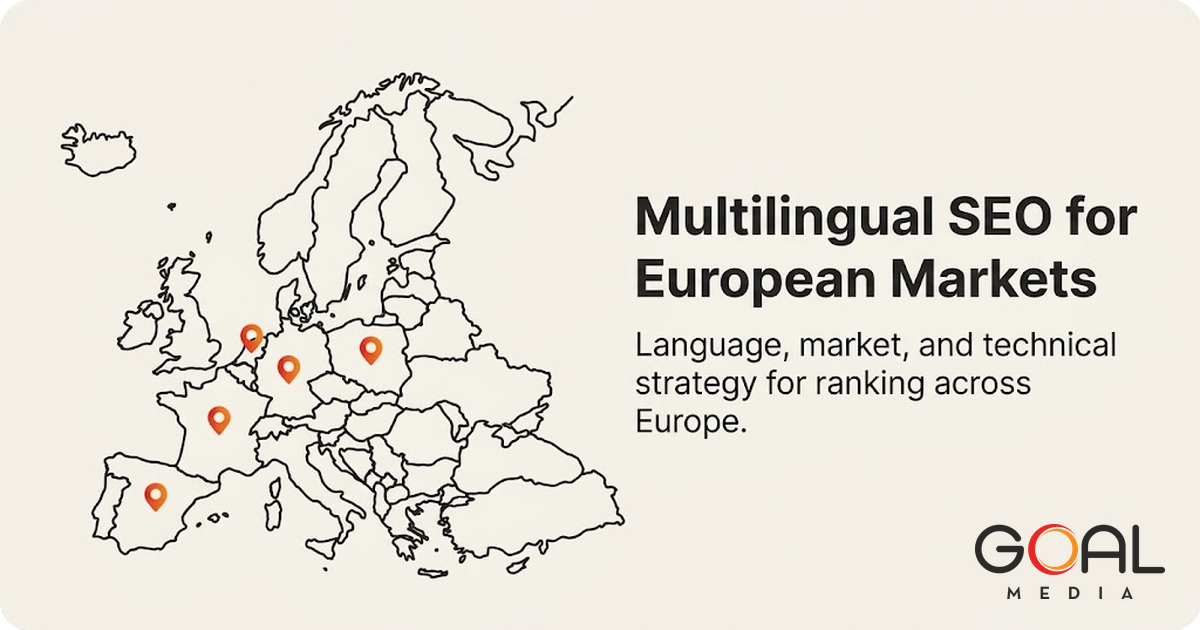
Most “international SEO” advice treats Europe as one big translation job: take your English site, run it through a translation service, add some hreflang tags, done. I’ve fixed enough broken European rollouts to tell you that approach fails in predictable ways, and it fails for reasons that have nothing to do with translation quality.
Europe isn’t one market. It’s a dense cluster of markets that share borders but not languages, share languages but not countries, and share regulations that actively interfere with how search engines crawl and render your site. Getting multilingual SEO right here means treating each of those layers separately.
The language-country mismatch problem
The first mistake I see is treating “language” and “country” as the same targeting decision. They’re not.
French isn’t just spoken in France. It’s the primary language in parts of Belgium and Switzerland too, and buyers in each of those markets search differently, use different currency and shipping expectations, and sometimes prefer different terminology for the same product. A single French-language page trying to serve France, Belgium, and Switzerland at once usually ends up ranking weakly in all three rather than strongly in one.
The fix is deciding, market by market, whether you need:
- One language variant serving multiple countries (acceptable when the buyer intent and regulatory content, like pricing and shipping, genuinely don’t differ)
- Separate variants per country even when the language is shared (usually the right call when currency, legal disclosures, or local competitors force real content differences)
This decision should come before you touch URL structure, not after.
URL structure: pick a structure your team can actually maintain
Subdomains, subfolders, and ccTLDs all work from a pure ranking standpoint. Google has said as much for years. I’ve written a longer breakdown of that specific trade-off in subfolder vs subdomain for international SEO, so I won’t repeat the full case here.
For European rollouts specifically, the deciding factor is almost never SEO. It’s operational: can your team realistically maintain separate hreflang, separate hosting or CDN configuration, and separate content workflows for the structure you’re choosing. I’ve seen agencies recommend ccTLDs for “maximum local trust signal” to clients who then can’t keep six country domains updated. A subfolder structure that actually gets maintained will outperform a ccTLD structure that goes stale within a year.
hreflang gets harder with more overlapping languages
hreflang implementation is where most European sites break, specifically because Europe has more language-country combinations packed into a smaller geographic area than almost anywhere else.
A German-language site might need to serve Germany, Austria, and Switzerland with three distinct hreflang tags even when two of those markets share nearly identical content. Miss the x-default tag, or get the language-region codes wrong (de-DE versus de-AT versus de-CH, not just “de”), and you end up with Google showing the wrong country’s page to the wrong audience, or worse, treating your regional variants as duplicate content and picking one to rank while ignoring the rest.
The most common hreflang error I still find in audits: reciprocal tagging that’s incomplete. If your France page references your Belgium page, your Belgium page needs to reference back, and both need to reference every other variant in the set, not just each other. On a five-market rollout that’s five tags per page, on every page. Miss one direction and the whole cluster becomes unreliable to search engines.
GDPR consent banners can block your own content from being crawled
This one catches people off guard because it looks like a legal compliance issue, not an SEO issue, until it starts suppressing rankings.
Cookie consent banners that gate content behind a “reject” click, or that use JavaScript-heavy consent management platforms that delay page rendering, can prevent Googlebot from seeing your actual content if the crawler doesn’t execute the consent flow the way a human visitor would. I’ve audited sites where the core page content was technically present in the DOM but effectively invisible to rendering because the consent script hadn’t fired yet when the page was crawled.
If you’re deploying across European markets, test your pages the way Google’s rendering engine sees them, not just how they look in a browser after you’ve already accepted cookies. Consent management is unavoidable under GDPR. Consent management breaking your indexing is not, and it’s usually a matter of how the banner is implemented rather than an inherent conflict.
Translation is not localization, and search behavior proves it
Even with structure and technical implementation solved, I still see European multilingual sites underperform because the content itself is a direct translation rather than a market-specific rewrite.
Keyword research needs to happen per language market, not once in English with the results translated afterward. Search terms don’t map one to one across languages. A German searcher and a Dutch searcher looking for the same service often use completely different phrasing, different levels of formality, and sometimes different assumed context, because what’s common knowledge in one market needs explaining in another.
The practical version of this: run keyword research natively in each target language before writing a word of content, not after. Translating a page that was written for English search intent tends to produce content that reads fine but doesn’t match how anyone in that market actually searches.
Prioritizing which markets to enter first
Not every business needs a five-country European rollout on day one. When I’m advising on sequencing, I look at three things: where existing traffic and inquiries are already coming from organically (even at low volume, this tells you where demand exists before you’ve invested anything), where a competitor is visibly weak, and which markets share enough language and regulatory overlap that the second and third markets become cheaper to add once the first is built properly.
Starting with the market where you already have some organic signal, even a handful of impressions, tends to compound faster than starting fresh in a market with zero existing footprint, purely because you’re building on top of relevance signals that already exist rather than starting from nothing.
Getting the market and language segmentation right at the start saves you from re-architecting hreflang and URL structure six months in, which is a much more expensive fix than getting it right the first time.