Every business gets one eventually. Doesn’t matter how good the work is. Someone had a bad day, a miscommunication happened, or a genuinely fair complaint landed in public view, and now there’s a one or two-star review sitting on your Google Business Profile for anyone researching you to see.
The instinct, almost universally, is to react fast and defend yourself. That’s usually the wrong move. I’ve watched a single defensive reply do more damage to a business’s reputation than the original review ever would have, because prospective customers don’t just read the review. They read how the business responded to it, and that response often tells them more than the complaint itself.
What A Response Is Actually For
Here’s the thing people miss: you’re not really writing for the person who left the review. Some of them will read your reply and reconsider. Most won’t. You’re writing for everyone else who finds that review later, deciding whether to trust you.
A calm, professional response to a harsh review does something a five-star review can’t: it shows how you handle things when something goes wrong. That’s genuinely more persuasive to a skeptical buyer than a wall of glowing praise, because anyone can collect nice reviews. Handling a bad one with composure is harder to fake.
Before You Respond, Slow Down
The single most common mistake is replying within the first ten minutes, while still frustrated. Read the review twice. Check if there’s anything factually true buried in it, even if the tone is unfair. Then write your reply somewhere other than the response box, so you’re not tempted to hit publish the moment you finish typing.
If the review is genuinely abusive, fake, or clearly posted by a competitor, that’s a different situation entirely, and I’ll get to that. But for the ordinary case, a real customer with a real complaint, slowing down before you type anything is what separates a response that helps from one that makes things worse.
What A Good Response Actually Looks Like
Acknowledge specifically, not generically. “We’re sorry you had a bad experience” reads as boilerplate, because it is. Reference the actual issue: the delay, the miscommunication, whatever it was. It shows you read the review rather than pasted a template.
Take ownership of what’s actually yours to own. If something genuinely went wrong on your end, say so plainly. Not with excessive apology, just a clear acknowledgment. If the complaint is partly unfair, you can still respond professionally without agreeing to a version of events that didn’t happen. There’s a difference between defensive and honest.
Move the conversation offline. Invite them to reach out directly, by phone or email, to sort it out. This does two things: it shows good faith to anyone reading, and it gets the actual resolution attempt out of a public comment thread where it rarely goes well anyway.
Keep it short. A long, detailed rebuttal reads as defensive even when every point is fair. Three or four sentences is usually enough. Save the detail for the private follow-up.
Skip the excuses. “We were short-staffed that week” or “our supplier let us down” might be true, but it reads as deflection to someone who doesn’t know your internal situation and doesn’t especially care. State what happened, what you’re doing about it, and stop there.
When The Review Is Fake, Unfair, Or Malicious
This happens more than people expect, and it needs a different approach entirely. A competitor leaving a fake review, someone who was never actually a customer, or content that violates Google’s policies (harassment, hate speech, conflict of interest) shouldn’t just get a polite public reply. It should get reported through Google’s official flagging process.
Reporting takes time to process, and Google doesn’t remove reviews just because a business disagrees with them. But for reviews that clearly violate policy, rather than simply being unflattering, it’s the correct channel, and I’d still post a brief, calm public response while the report is pending, since the review stays visible while the report is processed.
One thing I’d actively avoid: never accuse a reviewer publicly of being fake or a competitor unless you have real certainty. If you’re wrong, that reply becomes far more damaging than the original review ever was, and it stays there just as long.
What Not To Do, Because I’ve Seen All Of These Go Badly
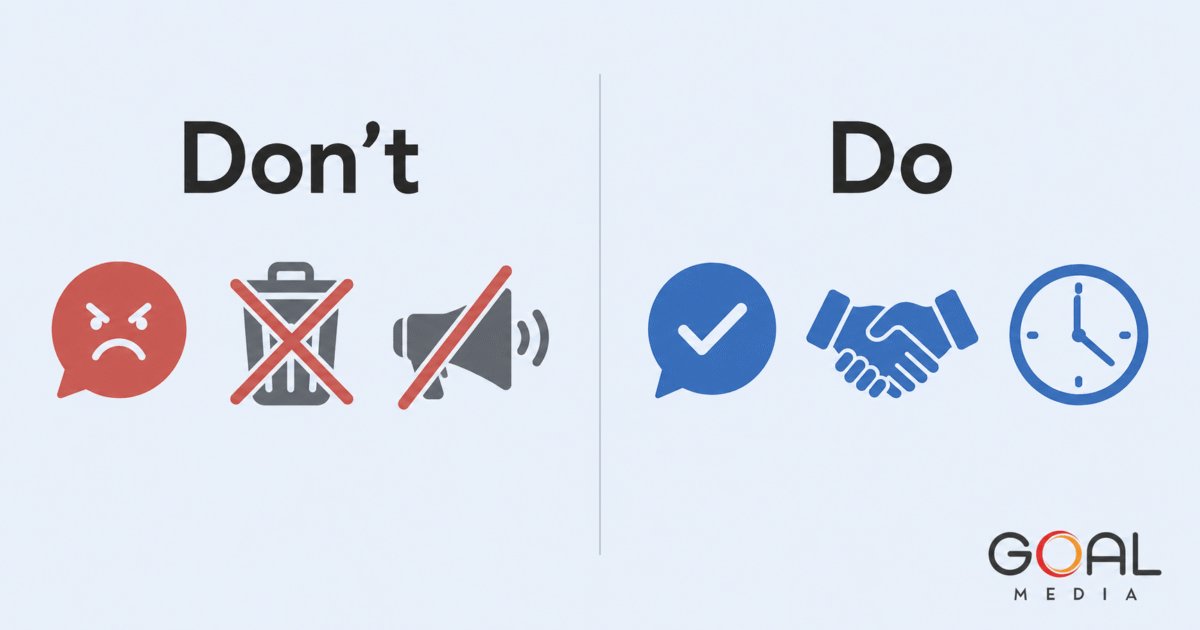
Arguing point by point in the replies. Getting sarcastic, even lightly. Offering a refund or discount publicly, since it invites everyone unhappy to leave a review hoping for the same deal. Deleting or hiding reviews you’re allowed to respond to but not remove. Asking loyal customers to “flood” the page with good reviews to bury a bad one, which usually reads as exactly what it is.
The common thread in all of these is that they’re optimized for the reviewer, or for venting, rather than for the hundred future customers who’ll read the exchange without any context beyond what’s on the page.
Responding Well Doesn’t Replace Preventing The Problem
A well-handled reply limits damage. It doesn’t undo the underlying issue if there’s a genuine pattern behind it. If the same complaint keeps showing up across multiple reviews, that’s not a reputation-management problem anymore, it’s an operations problem wearing a reputation-management costume. No response template fixes that. Worth being honest with yourself about which situation you’re actually in before assuming a better reply solves it.
A Simple Template To Adapt
Something close to this usually works for the ordinary, genuine-complaint case:
“Hi [name], thank you for the honest feedback, and I’m sorry [specific issue] didn’t go the way it should have. That’s not the experience we aim for. I’d like to make this right, please reach out to [email/phone] so we can sort it out directly.”
Adjust the tone to match your brand, but the structure holds: acknowledge specifically, take appropriate ownership, invite a direct resolution, keep it brief.
Where This Fits Into The Bigger Picture
Review response is one piece of a wider reputation picture, alongside how consistently you’re earning genuine reviews in the first place and how your business appears across search results generally. If you’re dealing with a pattern of reviews rather than a single one, or if your brand’s search presence needs a proper look, our reputation management services page covers how we approach it as a connected system rather than a one-off fire to put out.
Frequently Asked Questions
Should I respond to every negative review?
Generally, yes, especially anything with a specific complaint. A response shows future customers you’re engaged and take feedback seriously, even when the review itself is harsh. The exception is reviews that clearly violate platform policy, which are better reported than replied to at length.
Can I get a fake negative review removed?
Sometimes, if it genuinely violates the platform’s policies, such as being posted by someone who was never a customer, or containing harassment. Report it through the official channel and be patient, since review takes time. Google won’t remove a review just because it’s unflattering or because the business disagrees with it.
How quickly should I respond to a bad review?
Within a day or two is reasonable. Faster isn’t necessarily better, since a rushed, emotional reply usually reads that way. Taking a few hours to think it through and write something calm and specific matters more than speed.
Is it okay to offer a refund or discount in a public review response?
Better to move that conversation offline. Publicly offering compensation can encourage other customers to leave critical reviews hoping for the same treatment. Invite the reviewer to contact you directly, and handle any resolution there.